Mold Base and Mold: An In-Depth Analysis of Their Definitions, Functions, and Applications

In manufacturing, particularly in injection molding, the terms "mold base" and "mold" are frequently mentioned but often confused. Although closely related and working together in the mold manufacturing process, they have distinct definitions, functions, and applications. This article systematically analyzes the differences between mold bases and molds, providing a comprehensive understanding of these concepts and their roles in industrial production.
I. Fundamental Definition Differences
1. Definition and Characteristics of a Mold Base
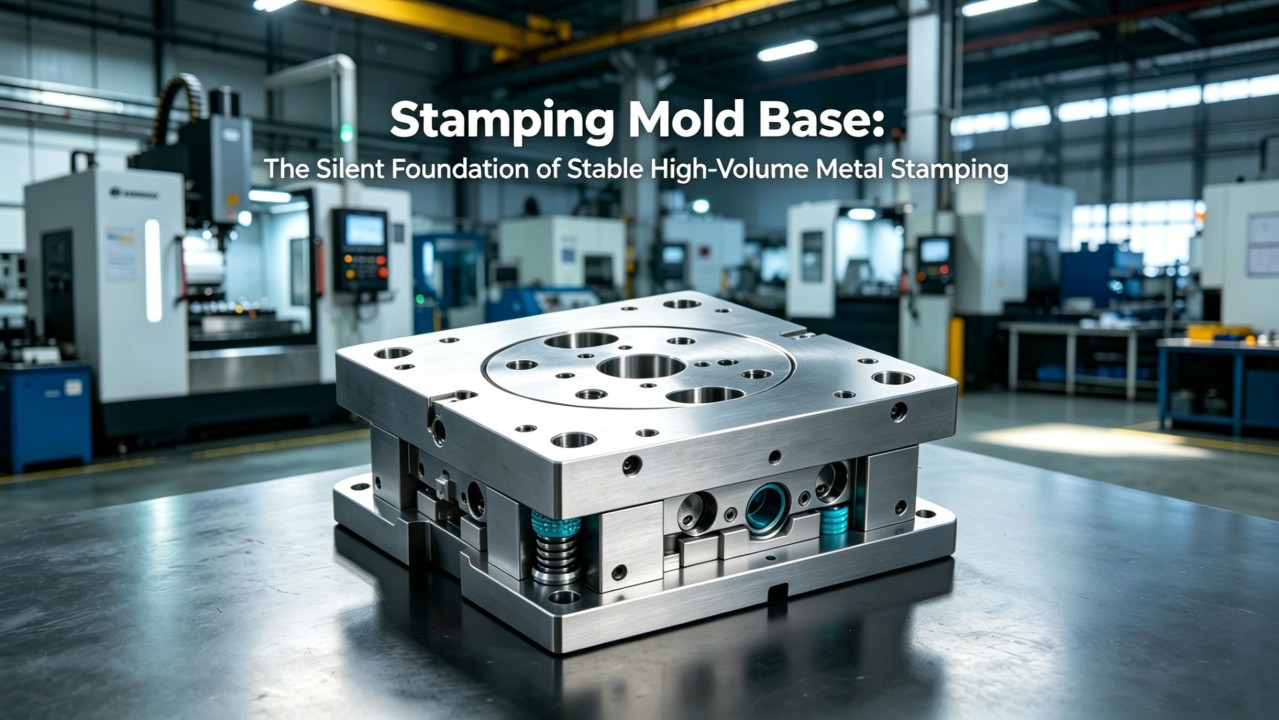
A mold base (or mold frame) refers to the supporting framework and foundational structure of a mold. It serves as the "skeleton" of the mold system, providing structural support and standardized mounting interfaces. A mold base typically consists of standardized components, including plates, guide pins, guide bushes, ejection systems, and other basic parts.
Key features of a mold base:
Highly standardized, available in serialized specifications
Does not directly participate in product shaping
Provides mechanical support and motion guidance for the mold
Usually mass-produced by specialized manufacturers
2. Definition and Characteristics of a Mold
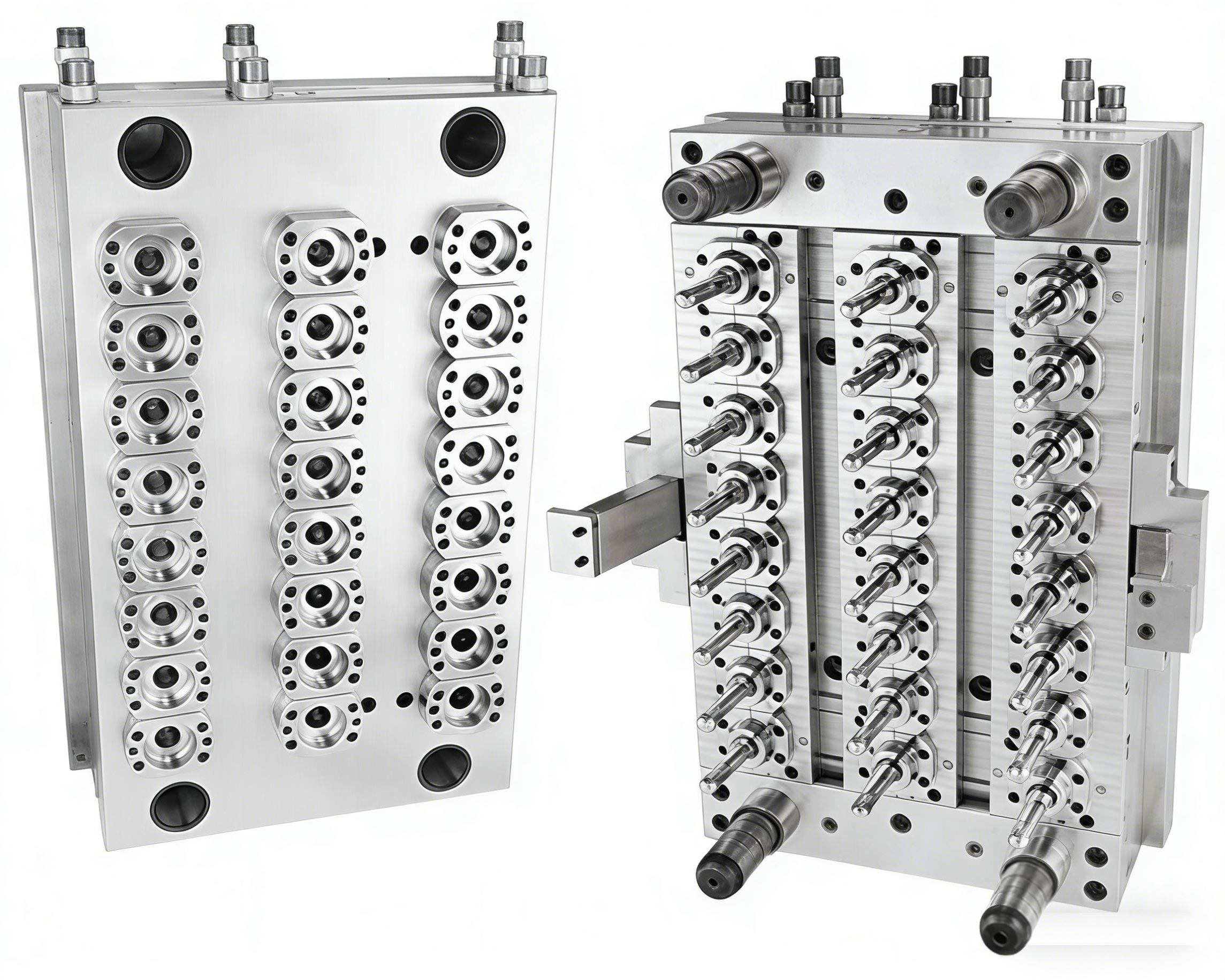
A mold (mold or die) is a specialized tool used to shape materials (such as plastic or metal) into specific forms. It contains the cavity and core structures that directly determine the final product's shape, dimensions, and surface quality.
Key features of a mold:
Highly customized, designed specifically for each product
Directly involved in the product-forming process
Includes complex cavity structures and cooling systems
Typically manufactured individually for each product
Critical distinction:
The mold base is the "skeleton" and support system of the mold.
The mold is the complete forming tool, including the mold base, with the core shaping components (cavity and core) mounted on the mold base to function properly.
II. Structural and Composition Differences
1. Typical Structure of a Mold Base
A standard mold base consists of the following key components:
Top Clamping Plate – Secures the mold to the moving platen of the injection molding machine
Bottom Clamping Plate – Fixes the mold to the stationary platen of the machine
Cavity Plate – Holds the cavity inserts
Core Plate – Holds the core inserts
Guide Pins & Guide Bushes – Ensure precise alignment during mold opening/closing
Ejection System – Includes ejector pins, ejector plates, etc.
Support Pillars – Enhance rigidity and prevent deformation
Return Pins – Reset the ejection system when the mold closes
2. Complete Structure of a Mold
A full mold includes not only the mold base but also the following functional components:
Forming Components – Cavity & core (directly shape the product)
Gating System – Sprue, runners, gates (guide molten material into the cavity)
Cooling System – Water channels and seals (regulate mold temperature)
Venting System – Allows air to escape from the cavity
Side-Action Mechanisms – Handle undercuts or side holes
Special Features – Hot runner systems, gas-assisted molding devices, etc.
Structural Comparison:
The mold base provides a standardized, universal support frame.
The mold adds highly customized shaping components to this frame—akin to a "skeleton vs. organs" relationship.
III. Functional Differences
1. Primary Functions of a Mold Base
Mechanical Support – Provides a sturdy foundation for mold components
Motion Guidance – Ensures precision in mold opening/closing via guide pins/bushes
Standardized Interfaces – Connects to injection molding machines uniformly
Ejection Mechanism – Facilitates part removal after molding
Quick Change Capability – Simplifies mold installation and maintenance
2. Comprehensive Functions of a Mold
Material Shaping – Forms raw material into the desired product
Precision Control – Maintains dimensional accuracy and consistency
Surface Finishing – Determines product texture and smoothness
Production Efficiency – Optimizes cycle times for faster manufacturing
Quality Assurance – Minimizes defects and ensures uniformity
Functional Relationship:
The mold base solves how to support and move the mold.
The mold solves how to shape the product.
IV. Design & Manufacturing Differences
1. Mold Base Design & Manufacturing
Standardized Design – Follows international (DME, HASCO) or national standards
Mass Production – Pre-made in various sizes and tonnages
Bulk Manufacturing – Often kept in stock for quick delivery
Materials – Medium-carbon or pre-hardened steels (e.g., P20, S50C)
Machining – Milling, grinding for flatness and alignment
Tolerances – Focus on plate parallelism and guide pin/bush fit
2. Mold Design & Manufacturing
Custom Design – Unique for each product
Single-Unit Production – Built specifically for one application
Complex Geometry – Intricate cavities, cooling channels, and mechanisms
Material Variety – Tool steels, stainless steel, beryllium copper, etc.
Precision Machining – EDM, high-speed milling, polishing
Surface Treatments – Hardening, chrome plating, nitriding
Manufacturing Comparison:
Mold bases are like standard parts (pre-made).
Molds are custom parts (designed and built per product).
V. Application Differences
1. Mold Base Applications
Foundation for new mold development
Prototyping and low-volume production
Replacement parts for mold maintenance
Training and educational demonstrations
Standardized interfaces for quick mold changes
2. Mold Applications
Injection Molding – Plastic products
Die Casting – Metal alloy parts
Stamping – Sheet metal components
Blow Molding – Hollow containers
Rubber Molding – Elastomer products
Application Scope:
Mold bases are limited to mold manufacturing and maintenance.
Molds extend to end-product manufacturing across industries.
VI. Procurement & Cost Differences
1. Mold Base Procurement & Cost
Available off-the-shelf from suppliers
Transparent pricing (standardized)
Short lead times (often in stock)
Cost: ~20-40% of total mold cost
Low maintenance, long lifespan
2. Mold Procurement & Cost
Custom-designed and built
Price varies widely (complexity-dependent)
Long lead times (weeks/months)
High maintenance (polishing, repairs)
Cost Relationship:
The mold base is a fixed cost.
The mold includes additional variable costs (design, machining).
VII. Future Trends
1. Mold Base Trends
Higher standardization (global systems)
Modular designs (quick assembly)
Smart integration (sensors for monitoring)
Lightweight materials
Faster mold-changing systems
2. Mold Trend
Ultra-high precision (micron/nano-level)
Increased efficiency (shorter cycles)
Smart molds (IoT-enabled controls)
Advanced processes (e.g., microcellular foaming)
Digitalization (CAD/CAE/CAM, digital twins)
VIII. Summary: Key Differences at a Glance
|
Aspect |
Mold Base |
Mold |
|
Definition |
Support frame of the mold |
Complete shaping tool |
|
Components |
Standard plates, guides, ejectors |
Mold base + cavities, cores, etc. |
|
Function |
Structural support & alignment |
Material shaping & finishing |
|
Design |
Standardized |
Customized |
|
Manufacturing |
Mass-produced |
Single-unit production |
|
Materials |
Medium-carbon steel |
Tool steels, alloys |
|
Precision |
Plate flatness, guide fit |
Cavity accuracy, surface finish |
|
Cost |
20-40% of mold cost |
Full custom cost |
|
Lifespan |
Long, reusable |
Shorter (wear-dependent) |
|
Supplier |
Mold base specialists |
Mold makers |
Conclusion
Understanding the differences between mold bases and molds is essential for professionals in the industry. The mold base ensures structural integrity, while the mold determines product quality. As manufacturing evolves toward smart and digital solutions, both components will see advancements—enhancing efficiency, precision, and innovation in production.
This progression will continue to drive industrial transformation and high-quality development in manufacturing.
From the Flood of Steel to the Mother of Precision: Unveiling the Complete Mold Production Chain
Plastic Injection Mold Bases: Exploring the "Skeleton" and Varieties
Related Article