Precision Preform Mold Bases: The Engineering Foundation of High-Performance PET Packaging
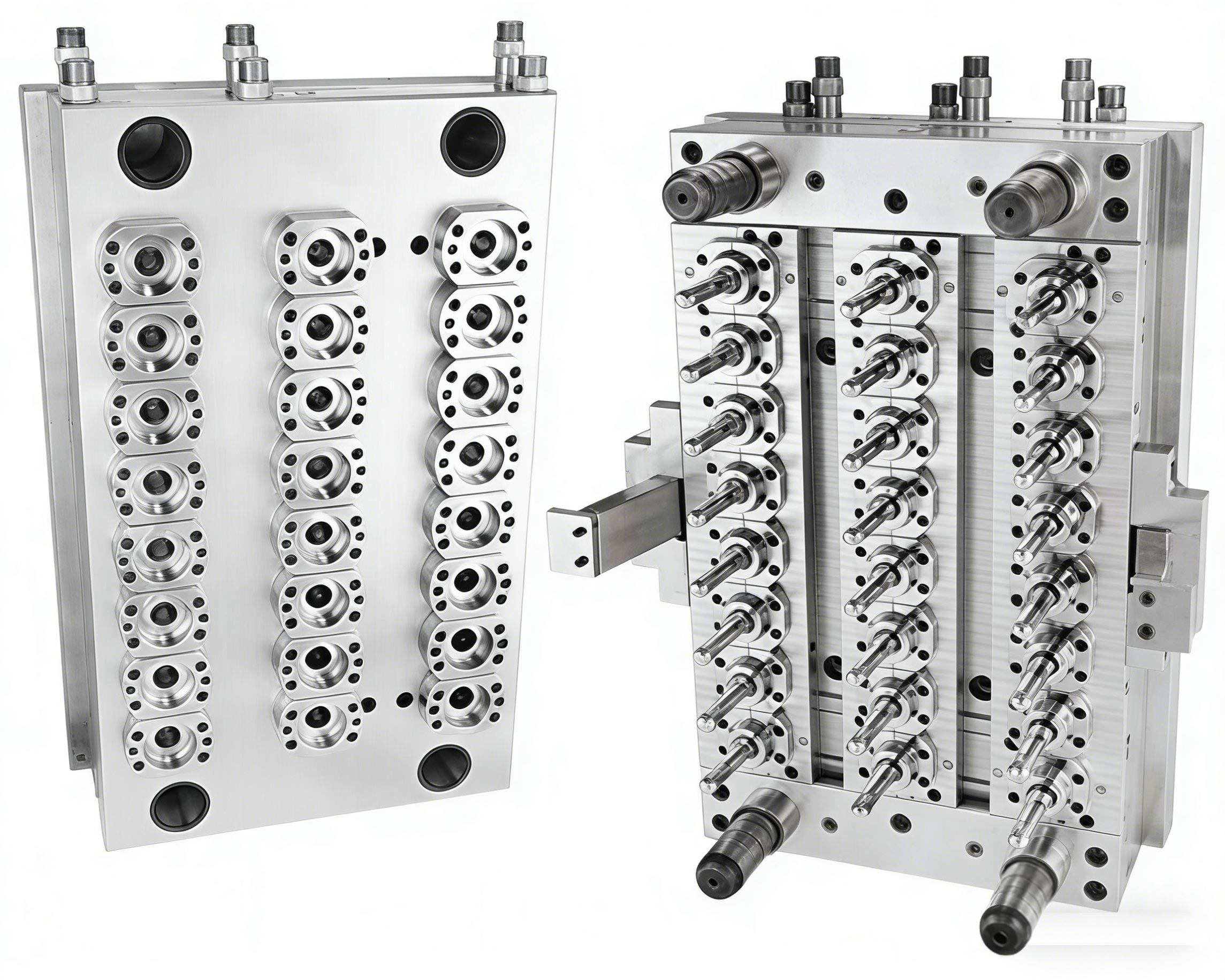
For PET bottle producers, the preform mold is the heart of production—but its performance is entirely dependent on the mold base that underpins it. As a specialized mold base manufacturer, we design and machine preform mold bases to meet the unique demands of high-cavity, high-cycle injection molding, where micron-level precision and long-term durability are non-negotiable.
1. Core Design Principles for Preform Mold Bases
Unlike general-purpose mold bases, preform mold bases are optimized for the specific geometry and production rhythm of PET preforms:
- Cavity & Core Alignment: Precision-ground guide pillars and bushings maintain sub-micron concentricity between cavity and core halves, eliminating preform wall-thickness variation and flash that lead to scrap and downstream blow-molding failures.
- Thermal Management: Optimized cooling channel layouts (often conformal or multi-zone) ensure uniform heat extraction across all cavities, directly reducing cycle time while preserving preform crystallinity and mechanical strength.
- High-Cavity Scalability: Our mold bases are engineered to support configurations from 24 to 96+ cavities, with reinforced plate structures and balanced load distribution to prevent deflection under repeated clamping pressures.
- Modularity & Serviceability: Standardized mounting interfaces for cavity inserts, core pins, and hot runner systems simplify maintenance, component replacement, and future mold reconfiguration—minimizing downtime for packaging producers.
2. Material & Machining: The Difference Between Reliability and Failure
The performance of a preform mold base is defined by its material selection and precision manufacturing:
- Material Choice: We use premium pre-hardened mold steels (e.g., P20, 1.2311) or quenched-tempered alloys (e.g., H13, 1.2344) to balance machinability, wear resistance, and thermal conductivity—critical for withstanding millions of injection cycles without dimensional drift.
- Precision Machining: 5-axis CNC milling, deep-hole drilling, and wire EDM ensure tight tolerances (±0.005mm) on locating rings, guide holes, and cooling passages. Final lapping and polishing of mating surfaces guarantee zero gap between mold halves during clamping.
- Stress Relief: Post-machining stress-relief processes eliminate residual stresses, preventing warpage and ensuring long-term dimensional stability—even under the thermal cycling of continuous PET production.
3. Why Investing in a Premium Preform Mold Base Matters
For packaging manufacturers, the mold base is not just a structural component—it’s a strategic investment that directly impacts bottom-line results:
- Reduced Operational Costs: Consistent alignment and thermal control lower scrap rates by up to 30% and extend mold service life by 20–40%, reducing the need for frequent repairs and replacements.
- Faster Time-to-Market: Modular design and standardized interfaces allow for quicker mold setup and retooling, enabling producers to respond faster to changing packaging trends and customer demands.
- Sustainable Production: Improved cooling efficiency reduces energy consumption per cycle, while longer mold life minimizes material waste—aligning with global sustainability goals in the packaging industry.
4. Our Commitment to Preform Mold Base Excellence
As a mold base manufacturer focused on the packaging sector, we work closely with preform mold makers and bottle producers to deliver custom solutions:
- Collaborative design reviews to optimize for specific preform geometries, production volumes, and blow-molding requirements.
- In-house quality control (CMM inspection, thermal cycling testing) to validate every mold base before delivery.
- Post-sales support for maintenance, reconditioning, and upgrades to extend the operational life of your tooling.
International Standard | Major Update of DME 2026 Mold Base Standard
Headline: Mold Base Material Selection: P20, 718H, or H13 – Are You Choosing Right?
Related Article