Core Impacts of CNC Technology on Mold Precision and Performance
1. Deterministic Enhancement of Mold Precision
1.1 Dimensional and Geometrical Accuracy Control
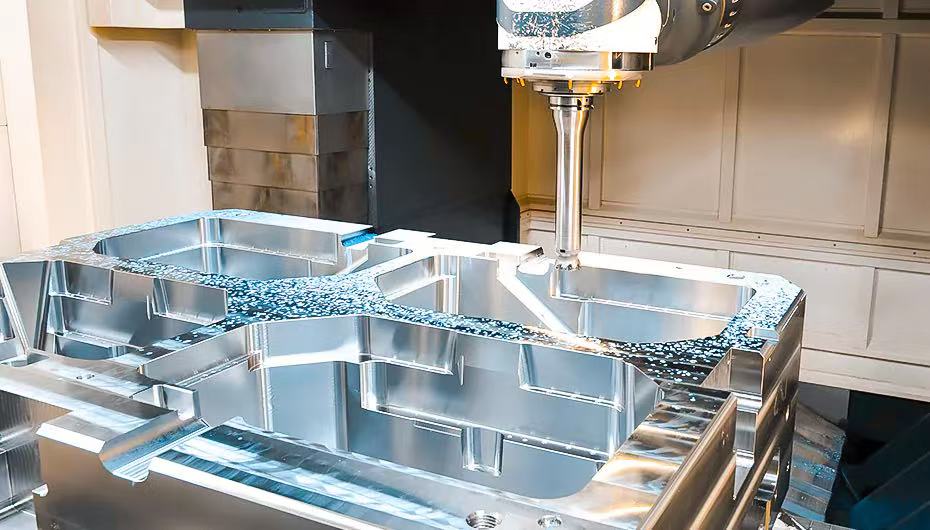
Five-axis simultaneous CNC technology enables continuous machining of complex curved surfaces. For instance, optical surfaces in automotive lamp molds are completely free from tool marks and stepping effects inherent in traditional three-axis machining, achieving surface continuity accuracy within ±0.005 mm. For deep-cavity molds, five-axis side milling technology eliminates surface roughness issues caused by ball-nose tools, maintaining sidewall perpendicularity errors within 0.01 mm/300 mm.
1.2 Fit and Alignment Accuracy Optimization
In large automotive panel mold manufacturing, gantry-type five-axis CNC machines control the uniform distribution of clearance between core and cavity halves within 0.02–0.03 mm, improving precision by over threefold compared to traditional methods. For multi-slide mechanisms in precision connector molds, machining all mating surfaces in a single setup reduces cumulative errors from 0.05 mm to 0.008 mm, increasing mold service life by 40%.
2. Technological Breakthroughs in Mold Surface Quality
2.1 Mirror-Finish Machining Capability
Utilizing high-speed cutting technology (spindle speeds of 30,000–60,000 rpm, feed rates of 15–30 m/min) coupled with specialized toolpath algorithms enables mirror-finish surfaces with Ra values of 0.05–0.1 μm on mold steel. This reduces demolding force for plastic parts by 35% while avoiding dimensional changes in critical areas associated with traditional polishing.
2.2 Micro-Texture Machining
CNC micro-milling technology can accurately produce textures such as leather or wood grain with widths of 0.02 mm and depths of 0.01 mm. For automotive interior mold texturing, precision reaches ±0.003 mm with texture consistency exceeding 98%, fully replacing chemical etching processes.
3. Comprehensive Optimization of Mold Structural Performance
3.1 Conformal Cooling System Manufacturing
Conformal cooling channels manufactured via hybrid 3D printing and CNC finishing maintain a uniform distance of 2±0.1 mm from the cavity surface. This improves cooling efficiency by 60%, reduces injection cycle time by 30%, and eliminates mold stress cracking due to thermal gradients.
3.2 High-Longevity Mold Manufacturing
For precision stamping dies, CNC hard machining technology can directly produce cutting edges on materials with hardness up to HRC 62, generating surface compressive residual stresses of 800–1000 MPa. This increases mold life by over 50% compared to grinding processes.
4. Reconfiguration of Manufacturing Efficiency and Cost
4.1 Machining Efficiency Data
High-speed milling achieves metal removal rates up to 1000 cm³/min, four to five times that of conventional machining. Intelligent toolpath planning reduces non-cutting movements by 60%, shortening overall machining time by 40%. Processing time for large automotive molds has decreased from 1200 to 700 hours.
4.2 Cost Control Metrics
In-process measurement systems automatically compensate for tool wear, reducing rework rates from 8% to 1.5%. Intelligent scheduling increases machine utilization from 65% to 85%, lowering unit mold manufacturing costs by 25–30%.
4.3 Quality Consistency Assurance
Digital manufacturing processes ensure batch-to-batch variation of critical mold dimensions remains below 0.005 mm, raising first-trial success rates from 70% to 95%. Mold data management systems enable full lifecycle traceability, reducing maintenance costs by 40%.
5. Integration of Advanced Technologies
5.1 Intelligent Error Compensation
Digital twin-based error prediction systems analyze 16 error sources—including machine thermal deformation and cutting force deflection—to enable proactive accuracy compensation, improving large mold machining precision stability by 70%.
5.2 Hybrid Manufacturing Technology
In mold repair applications utilizing additive-subtractive hybrid manufacturing, the accuracy of clad layers reaches 0.02 mm with hardness matching of 95%, at only 30% of the cost of a new mold.
6. Industry Application Examples
Precision Connector Molds: Utilizing Swiss precision CNC machining, pin position accuracy achieves ±0.002 mm, with mold life exceeding 5 million cycles and product yield increasing from 92% to 99.8%.
Optical Lens Molds: Five-axis ultra-precision machining achieves aspheric surface form accuracy of 0.1 μm and surface roughness of Ra 3 nm, fully meeting requirements for high-end optical products.
Conclusion
The impact of CNC technology on mold manufacturing has evolved from point-specific breakthroughs to systemic reconfiguration. It has not only achieved order-of-magnitude improvements in precision but has also, through digitalization and intelligent methods, propelled the design freedom, manufacturing efficiency, and comprehensive performance of molds to new heights. Mastering and deeply applying CNC technology has become essential for mold enterprises to compete in high-end manufacturing. In the future, with further integration of artificial intelligence and CNC technology, mold manufacturing will continue evolving toward an intelligent paradigm characterized by "zero defects, self-adaptation, and full traceability."
From "Skeleton" to "Mapping": The Profound Impact of Product Design on Mold Bases
An Industry Under Pressure: How Slumping Global Auto Demand Reshapes Mold Manufacturing
Related Article